✨ VS Analyses · VacuumSpain comparison technology. Explanation created with AI from verified technical data.
Introduction
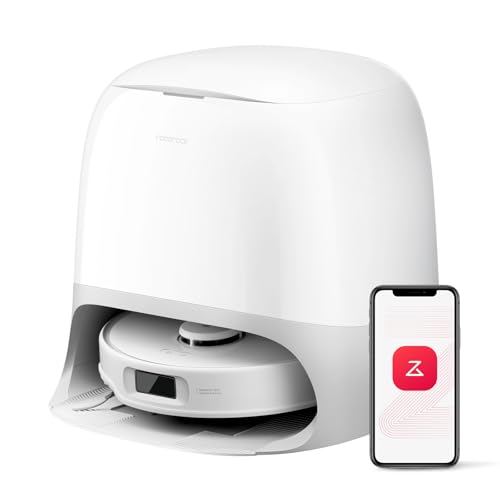
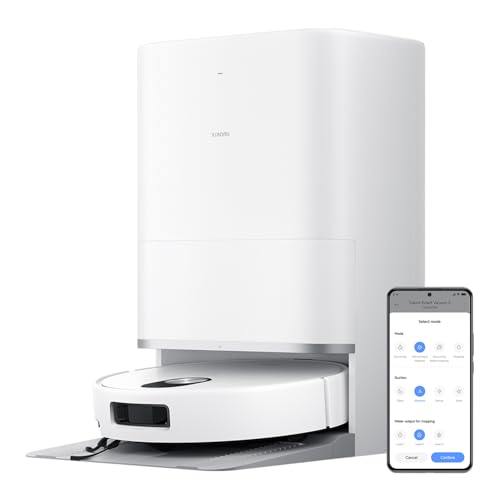
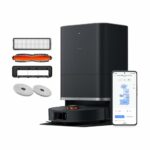
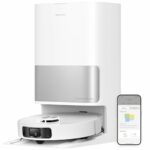
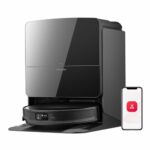
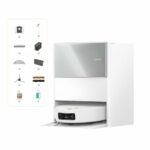
Choosing between the Roborock Qrevo Curv S5X and the Xiaomi Robot Vacuum 5 is not straightforward. We're talking about two high-end propositions launched just months apart: the Roborock came to light in 2024, whilst Xiaomi presented its model in 2025. Both units feature a multifunction base that washes and dries the mops, a mopping system with two rotating mops and the ability to overcome obstacles up to 20 mm.
The Roborock relies on its consolidated experience as a world leader in robot vacuum cleaners, with proprietary technologies such as the DuoDivide brush and the SmartPlan 2.0 system. Xiaomi, a manufacturer that shares technology with Dreame in many of its models, has opted for a more compact design and suction power that reaches 20000 Pa. This robot vacuum cleaner comparison will help you decide which option best suits your real needs.
Power and Suction
In terms of raw power, the Xiaomi Robot Vacuum 5 comes out ahead with its 20000 Pa of suction, surpassing the Roborock Qrevo Curv S5X's 18500 Pa. This difference can be particularly noticeable on medium-pile carpets or when vacuuming heavier debris embedded in the fibres.
The brushing system marks an important technical difference. The Roborock robot vacuum cleaner uses the DuoDivide anti-tangle brush, a brand-specific design that pushes hairs towards the central gap to facilitate suction and reduce tangles. The Xiaomi incorporates the TriCut 3.0, which combines bristles with blades that cut hairs during brushing. Both systems are designed to reduce maintenance, although they work differently.
Both models include an extendable and anti-tangle side brush, which improves cleaning in corners. Neither raises the main brush during mopping, something common in this price range.
Mopping
Here we find relevant differences that can shape the user experience. Both robots mop with two rotating mops and feature extension to better reach edges. The Roborock uses its FlexiArm system to extend the mop, whilst the Xiaomi also offers this function without a specific commercial name.
Mop lifting works differently: the Xiaomi Robot Vacuum 5 can raise them up to 15 mm, compared to the Roborock's 10 mm. This can be useful on thicker carpets or when moving from hard floor to carpet without needing to remove the mops manually.
Mop washing in the base is where interesting nuances appear. The Xiaomi robot vacuum cleaner washes the mops with water at 80°C, a higher temperature than the Roborock's 75°C. In practice, both values are sufficient to eliminate bacteria and adhered dirt. The Roborock dries the mops with hot air at 45°C, whilst the Xiaomi also uses hot air without specifying exact temperature.
An exclusive function of the Roborock Qrevo Curv S5X is dirt detection, both on the mops and on the floor. This allows the robot to identify dirtier areas and go over them again or rewash the mops when it detects they are not sufficiently clean. The Xiaomi does not incorporate this technology, which means it follows cleaning patterns without adapting to the actual dirt detected during mopping.
Navigation System
The Roborock mounts a Lidar 3.0 turret, a traditional system that protrudes slightly from the robot's body. The Xiaomi opts for a retractable lidar, a design that reduces the unit's total height and avoids bumps on low furniture. This difference partly explains the Xiaomi model's 10 mm less in height.
The Xiaomi robot vacuum cleaner incorporates a front 3D laser sensor, technology that improves detection of small obstacles on the floor. The Roborock does not include this sensor, although it compensates with its obstacle avoidance system integrated into navigation. Neither unit features a front camera nor remote camera access.
The Roborock uses its RR Mason 11.0 algorithm together with the SmartPlan 2.0 function, which intelligently optimises cleaning routes. The Xiaomi also offers intelligent cleaning with AI, although it does not specify the name of the processor or algorithm used. In practice, both systems are capable of mapping the home and creating efficient routes.
Autonomy and Battery
Both robots mount 5200 mAh batteries, but performance differs. The Roborock Qrevo Curv S5X reaches 180 minutes of autonomy, whilst the Xiaomi Robot Vacuum 5 stays at 140 minutes. This 40-minute difference can be decisive in large homes or when carrying out complete cleans including mopping.
For homes over 150 square metres, the Roborock's greater autonomy can prevent the robot from having to return to the base mid-clean to recharge. The Xiaomi, with its 140 minutes, is still sufficient for most households, but this factor should be considered if the surface to be cleaned is extensive or if there are many fragmented rooms.
Smart Functions
Both robots can overcome obstacles up to 20 mm in height, which allows them to navigate thick cables, carpets or small level changes between rooms. Neither incorporates a robotic arm nor its own voice assistant, functions usually reserved for higher ranges or specific models from other brands.
Multifunction Cleaning Base
Both bases feature an auto-cleaning system for the washing tray, a function that reduces manual maintenance. The Roborock specifies that it uses its 2.0 system, although in practice both bases perform this task automatically after each cleaning cycle.
The dust bag capacity is identical: 2.5 litres in both cases. The clean water tanks also match at 4 litres. The difference lies in the dirty water tank: the Xiaomi offers 3.8 litres compared to the Roborock's 3 litres. This can translate into fewer manual emptyings when mopping large surfaces.
Neither model includes a detergent tank, UV disinfection nor the possibility of connection to water pipes. Nor do they offer an optional kit for this function.
Dimensions
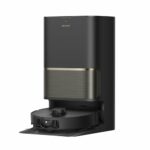
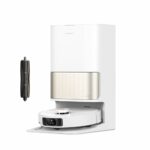
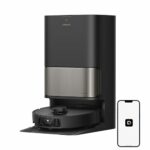
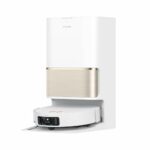
The diameter is practically identical: 352 mm on the Roborock compared to 350 mm on the Xiaomi. The important difference is in height: the Xiaomi robot vacuum cleaner measures 88 mm, whilst the Roborock reaches 98 mm. Those 10 mm can make the difference when trying to pass under certain furniture, sofas or beds with little clearance from the floor.
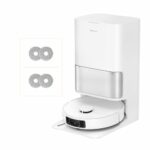
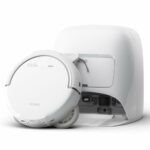
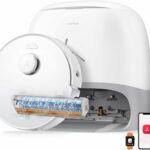
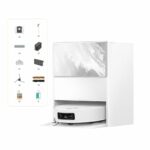
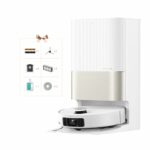
The bases' dimensions are different. The Roborock's forms a cube of 450 mm on all sides in all directions. The Xiaomi's is narrower (360 mm wide) but taller (572 mm) and somewhat deeper (470 mm). Depending on the available space at home, a square base or a narrower and taller one may be more convenient.
Real-World Experience
For large homes, the Roborock Qrevo Curv S5X is more suitable thanks to its 180 minutes of autonomy. This allows completion of cleans over 200 square metres without intermediate recharges. The Xiaomi, with 140 minutes, works well in flats up to 120-150 square metres.
If there are pets at home, both anti-tangle brushes fulfil their function well, although the Roborock's DuoDivide system has a reputation for requiring less maintenance with long hair. The Xiaomi, with its greater suction power, may be somewhat more effective on carpets with embedded pet hair.
The Xiaomi is the most practical option for passing under low furniture. Its 88 mm height allows it to access spaces where the Roborock, at 98 mm, may have difficulties. This becomes important in living rooms with low-legged sofas or bedrooms with low-height bed bases.
The Roborock's dirt detection provides an extra level of effectiveness in mopping. In kitchens or areas where more dirt accumulates, the robot automatically goes over them again until the floor is clean. The Xiaomi mops in a more standard way, without adapting to the actual dirt detected.
Conclusion: Which to Choose?
Choose the Roborock Qrevo Curv S5X if: You have a large home over 150 square metres and value autonomy. Also if you seek maximum effectiveness in mopping thanks to dirt detection on mops and floor. It's the most complete option for those who trust Roborock as a leading brand and want a robot that intelligently adapts to real cleaning needs. Its SmartPlan 2.0 system and DuoDivide brush are solid arguments if minimal maintenance is a priority.
Choose the Xiaomi Robot Vacuum 5 if: You need a lower robot that can pass under furniture with little height. Its 88 mm is a real advantage in many homes. Also if you value the greater suction power (20000 Pa) for carpets or if you prefer a more recent model (2025) with retractable lidar and front 3D laser sensor. The larger dirty water tank and narrower base can be decisive factors depending on the available space at home. It's an excellent alternative for medium-sized homes where the 140-minute autonomy is sufficient.