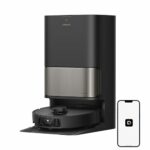
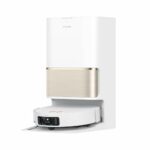
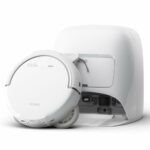
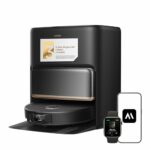
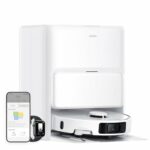
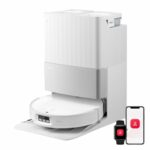
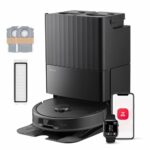
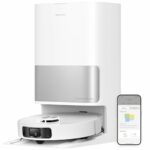
✨ VS Analyses · VacuumSpain comparison technology. Explanation created with AI from verified technical data.
Introduction
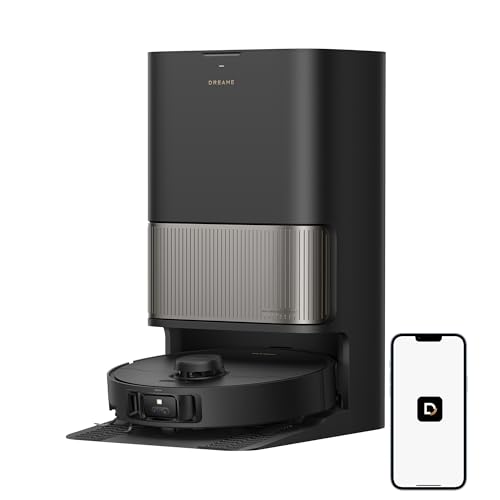
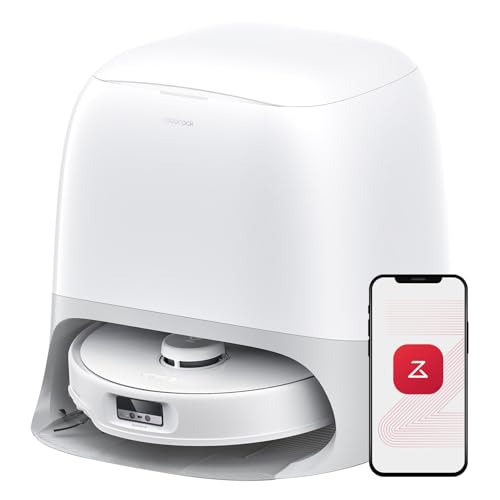
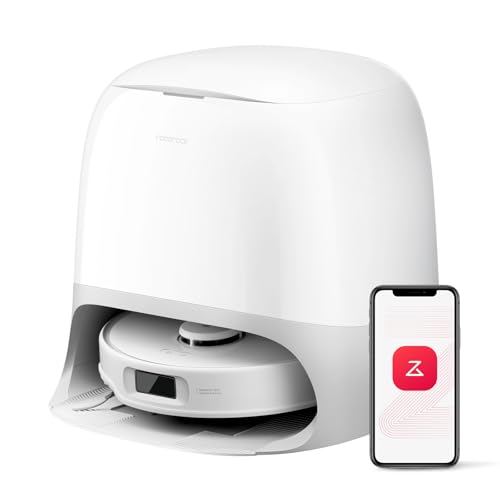
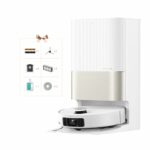
The Dreame L40s Pro Ultra arrives on the market in 2025 as the Chinese brand's latest offering, going head-to-head with two Roborock options launched in 2024: the Qrevo Curv and the Qrevo Curv S5X. All three units belong to the premium range of robot vacuum cleaners with multifunctional base stations, designed to offer complete autonomous cleaning for both vacuuming and mopping. The main difference between the two Roborock models is that the S5X represents a more accessible version, with some features scaled back compared to the standard Qrevo Curv.
These are robots designed for users looking to completely delegate household cleaning tasks, especially in medium or large-sized homes where autonomy and tank capacity are decisive factors.
Power and Suction
The Dreame L40s Pro Ultra sits slightly ahead in raw power with 19,000 Pa, whilst the Roborock Qrevo Curv and the S5X remain at 18,500 Pa. In practice, this 500 Pa difference may be noticeable especially on thick carpets or when dealing with ingrained dirt, although both levels belong to the highest range on the current market.
More relevant is the difference in brushing systems. The Dreame model is equipped with a dual HyperStream brush specifically designed to prevent hair tangles, something that can make a difference in homes with pets. Both Roborock models opt for the DuoDivide brush, which pushes hair towards the central gap to facilitate direct suction. Both approaches are effective, although the Dreame system tends to require less manual maintenance.
A clear advantage of the Dreame L40s Pro Ultra is that its side brush lifts during mopping, preventing it from interfering with the mops or dragging wet dirt. The Roborock models keep the side brush active at all times. All three models feature an extendable side brush to improve corner cleaning, and all lift the main brush when mopping, thus protecting the fibres and preventing them from getting unnecessarily wet.
Mopping
All three robots feature dual rotating mop systems, the current standard in the premium range. The Dreame adds the Roboswing system, which allows the robot to perform a lateral movement to introduce the mops under furniture and overhangs, something the Roborock models don't offer.
Regarding mop lifting, the Roborock Qrevo Curv stands out with a capacity of between 10 and 20 mm, adapting to the type of obstacle. The Dreame reaches 10.5 mm and the S5X remains at 10 mm. These differences matter when the robot needs to pass over carpets or thresholds without wetting them.
An exclusive feature of the Dreame L40s Pro Ultra is its ability to automatically detach the mops at the base station when it only needs to vacuum. This prevents dragging dry mops across the floor during pure vacuuming sessions, reducing wear and improving efficiency. The Roborock models don't have this function.
All three units feature dirt detection on both the mops and the floor, automatically adjusting mopping intensity and deciding when it's necessary to return to the base station to wash the mops. The base stations of all three models wash the mops with hot water and dry them with hot air, guaranteeing hygiene and preventing bad odours.
Navigation System
Notable differences appear here. The Dreame L40s Pro Ultra and the Roborock Qrevo Curv share an advanced configuration with LiDAR turret, dual AI camera, front 3D laser sensor and LED for night vision. This allows them to navigate precisely even in low-light conditions and remotely access the camera from the app.
The Roborock Qrevo Curv S5X, however, dispenses with the AI camera and the front 3D laser sensor, which limits its object recognition capability and precision in complex environments. It also doesn't include remote camera access or front LED.
The Dreame recognises up to 180 different types of obstacles, a figure far superior to the 62 of the Roborock Qrevo Curv. Additionally, the Dreame detects curtains and can avoid them during cleaning, a function that doesn't appear on any of the Roborock models. Both premium models recognise pets, something the S5X doesn't do.
For homes with many objects on the floor, young children or pets, these differences in navigation and artificial intelligence are decisive.
Autonomy and Battery
The Roborock Qrevo Curv features a 6,400 mAh battery that grants it up to 240 minutes of autonomy, the highest figure of the three. The Dreame L40s Pro Ultra and the Roborock Qrevo Curv S5X share battery capacity (5,200 mAh), but the Dreame achieves 220 minutes versus the S5X's 180.
This difference suggests that the Dreame manages energy more efficiently, probably thanks to its CleanGenius intelligent cleaning algorithm. In large homes, those extra 40 minutes can mean completing the cleaning without needing an intermediate recharge.
For houses over 150 square metres, the Roborock Qrevo Curv offers the greatest peace of mind regarding autonomy. The Dreame comes second, whilst the S5X may require additional recharges in large spaces.
Smart Functions
All three robots can overcome steps, although with differences. The Dreame L40s Pro Ultra and the Roborock Qrevo Curv are prepared to navigate simple steps of height not specified in detail, whilst the S5X has a clear limit of 20 mm. In practice, this affects the ability to pass over high thresholds or small level differences between rooms.
The Dreame L40s Pro Ultra and the Roborock Qrevo Curv incorporate their own voice assistant, allowing commands to be given directly to the robot without going through Alexa or Google Home. The S5X doesn't have this function, although it is compatible with external assistants.
Multifunctional Cleaning Base Station
All three base stations perform auto-emptying of the dust container, mop washing with hot water and drying with hot air. The most relevant difference is in the self-cleaning of the washing tray: the Dreame incorporates a third-generation system, whilst both Roborock models feature the 2.0 version. This translates to less frequent base station maintenance in the case of the Dreame.
Only the Dreame L40s Pro Ultra includes a detergent tank in the base station, dispensing it automatically during mop washing. The Roborock models require manually adding the product to the clean water tank if detergent is desired.
Regarding capacities, the Dreame offers a 3.2-litre dust bag versus the 2.5 litres of the Roborock models. It also has more generous water tanks: 4.5 litres of clean water and 4 litres of dirty water, versus 4 and 3 litres respectively for the Roborock models. For large houses or users who prefer to empty and refill less frequently, these differences count.
The Dreame allows the purchase of an optional kit to connect the base station directly to water pipes, eliminating the need to manually refill and empty tanks. The Roborock models don't offer this option.
Dimensions
All three robots have a practically identical diameter, around 350 mm. In height, the Roborock Qrevo Curv S5X is the lowest at 98 mm, followed by the Qrevo Curv at 103 mm and the Dreame at 103.8 mm. Those 5 mm difference between the S5X and the other two may allow it to slip under furniture where the others can't fit.
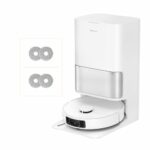
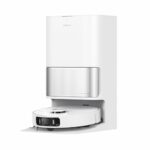
The base stations present more marked differences. The Dreame's measures 340 mm wide, 456.7 mm deep and 590.5 mm high, being narrower but considerably taller than the Roborock ones. Both Roborock base stations are cubic, with 450 mm in all three dimensions, occupying more floor space but being lower. Depending on where the base station is placed, these differences may be relevant.
Real-World Usage Experience
For large homes, the Roborock Qrevo Curv offers the greatest autonomy thanks to its 6,400 mAh battery, although the Dreame L40s Pro Ultra compensates with larger tanks in the base station, reducing user interventions. The S5X is more limited in large houses due to its lower autonomy.
If you live with pets, the Dreame's dual HyperStream brush system requires less maintenance than Roborock's DuoDivide. Additionally, its ability to recognise 180 types of obstacles and specifically detect pets gives it an advantage in homes with animals that leave toys or feeding bowls on the floor.
The Dreame also stands out in ease of use thanks to automatic mop detachment, the integrated detergent tank and the possibility of connecting the base station to pipes via optional kit. For users seeking maximum autonomy and minimum maintenance, these functions make a difference.
The Roborock Qrevo Curv S5X is more limited by lacking an AI camera and 3D laser sensor, which reduces its precision in complex environments. It's a more basic option within the premium range, suitable for homes without too many obstacles and users who don't need remote camera access or advanced object recognition.
Conclusion: Which to Choose?
Choose the Dreame L40s Pro Ultra if you're looking for the maximum level of autonomy and convenience, you value the integrated detergent tank, you have pets and prefer a brushing system that requires less maintenance. Also if you're interested in curtain detection, automatic mop detachment and the option to connect the base station to pipes. Its greater tank capacity and recognition of 180 obstacles make it the most complete option for large houses with complex environments.
Choose the Roborock Qrevo Curv if autonomy is your absolute priority and you need a robot capable of cleaning very large surfaces without intermediate recharges. Its 6,400 mAh battery is the most generous, and it features advanced navigation via dual AI camera and 3D laser sensor. It's ideal for large homes where battery life is critical, although it requires more manual intervention by not having a detergent tank or automatic mop detachment.
Choose the Roborock Qrevo Curv S5X if you're looking for a more economical option within the premium range, your home doesn't exceed 100-120 square metres and you don't need advanced functions such as AI camera, pet recognition or remote access. Its lower height (98 mm) allows it to slip under low furniture, and it maintains the basic quality mopping and vacuuming features, although with lower autonomy and more limited navigation capabilities.