✨ VS Analyses · VacuumSpain comparison technology. Explanation created with AI from verified technical data.
Introduction
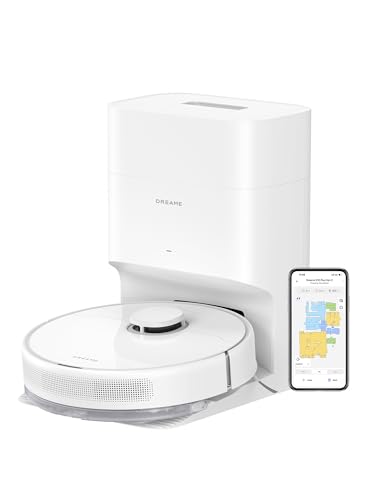
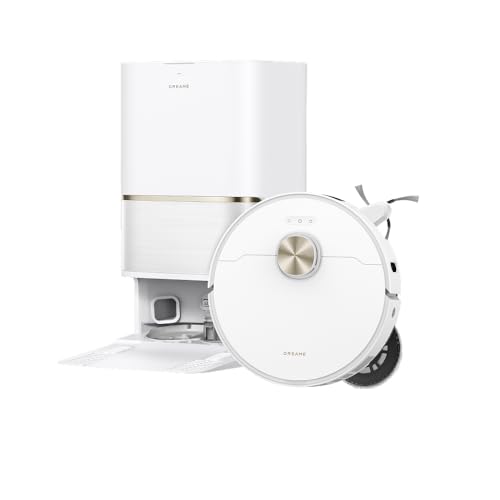
When we talk about Dreame robot vacuum cleaners, we find very different propositions depending on the level of automation you're looking for. The Dreame D10 Plus Gen 2, launched in 2024, represents a solution focused on vacuuming with basic auto-emptying. In contrast, the Dreame L50 Ultra AE positions itself as a complete cleaning system with a multifunctional base, designed for those seeking total autonomy in both vacuuming and mopping.
The difference between the two isn't just about price or features, but about concept. One is designed for homes where mopping isn't a priority or is preferred to be done manually. The other is committed to completely delegating both tasks to the robot, with all the advantages that brings in terms of maintenance and results.
Power and Suction
The gap in suction power is evident: 6,000 Pa on the Dreame D10 Plus Gen 2 versus 28,000 Pa on the Dreame L50 Ultra AE. This difference translates into real capacity to extract ingrained dirt from carpets or suction heavier particles. For hard floors and daily maintenance, 6,000 Pa may be sufficient, but when there are pets or medium-to-long pile carpets, the superior power makes a notable difference.
The brushing system also differs. The D10 Plus Gen 2 features a conventional simple brush, whilst the L50 Ultra AE incorporates the TriCut 3.0, specifically designed to reduce hair tangles. Additionally, the latter can lift the main brush during mopping, preventing it from getting unnecessarily wet or dragging wet dirt across already clean areas.
Regarding the side brush, the L50 Ultra AE adds two advantages: extension to better reach corners and anti-tangle technology. The D10 Plus Gen 2 lacks both functions. In practice, this means the advanced model sweeps corners more effectively and requires less manual maintenance to remove tangled hair.
Mopping
Here we find one of the most important differences in this robot vacuum comparison. The Dreame D10 Plus Gen 2 uses a static mop that drags across the floor without its own movement, without lifting and without automatic washing capability. It's a basic system that can serve for light maintenance, but requires changing or washing the mop manually.
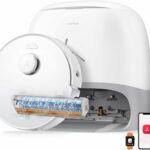
The Dreame L50 Ultra AE, on the other hand, features two rotating mops that extend to reach edges and can lift up to 10.5 mm when it detects carpets or rugs. During cleaning, the robot returns to the base to wash the mops with hot water, ensuring it always mops with clean cloths. When finished, it dries them with hot air to prevent bad odours and bacteria.
The automatic mop removal function allows the L50 Ultra AE to perform vacuum-only sessions without needing to remove them manually. This feature is especially practical when combining different cleaning routines depending on areas of the home.
Navigation System
Both models use LiDAR 3.0 turret to map and navigate the home, guaranteeing orderly and efficient routes. However, the Dreame L50 Ultra AE adds obstacle avoidance and front 3D laser sensor, capabilities absent on the D10 Plus Gen 2.
This difference directly affects the robot's autonomy. The basic model can get stuck more easily with cables, slippers or small objects. The L50 Ultra AE detects these obstacles before colliding and adjusts its trajectory, reducing manual interventions and increasing the completion rate of unsupervised cleaning sessions.
Autonomy and Battery
Both feature a 5,200 mAh battery. The Dreame D10 Plus Gen 2 declares 285 minutes of autonomy, a figure that isn't available for the L50 Ultra AE in the technical documentation. Considering that both share battery capacity but the latter has much greater suction power, it's reasonable to expect its autonomy to be lower in maximum power modes.
For medium-sized homes, the 5,200 mAh battery is sufficient in either case. In large houses, the robot may need intermediate recharging, a function that both manage automatically, resuming cleaning where they left off.
Smart Functions
Both robots can overcome obstacles up to 20 mm in height, which allows crossing transitions between rooms, thick carpets or small level changes. Both are compatible with external voice assistants such as Alexa or Google Home, facilitating control by voice commands.
The main smart difference lies in the obstacle avoidance of the L50 Ultra AE, which we've already mentioned. This function makes the robot a more autonomous option for homes with young children, pets or floors where objects are usually scattered.
Multifunctional Cleaning Base
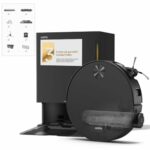
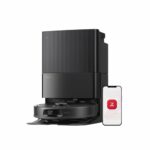
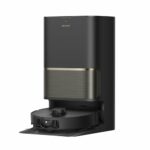
The Dreame D10 Plus Gen 2 incorporates an auto-emptying base with a 4-litre bag. It vacuums dust from the robot's dustbin after each clean, reducing maintenance to changing the bag every month or two depending on use. It doesn't include mop washing or drying functions because its mopping system is manual.
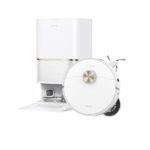
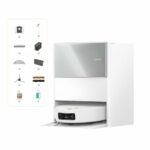
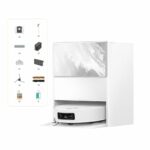
The Dreame L50 Ultra AE offers a complete multifunctional base: dust auto-emptying into a 3.2-litre bag, mop washing with hot water, drying with hot air and self-cleaning of the third-generation washing tray. The clean and dirty water tanks have capacities of 4.5 and 4 litres respectively. Additionally, it has a detergent tank to add cleaning product during mop washing.
This model includes the possibility of purchasing an optional kit for connection to plumbing, avoiding manually filling and emptying tanks. Although it's a separate accessory, it's worth bearing in mind if you're seeking maximum automation.
Dimensions
The robots share a diameter of 350 mm, but the Dreame D10 Plus Gen 2 measures 96.3 mm in height versus the 97 mm of the L50 Ultra AE. A minimal difference that doesn't affect the ability to slip under furniture.
The bases present more notable differences. The D10 Plus Gen 2's occupies 298 mm width, 406 mm depth and 427 mm height. The L50 Ultra AE's grows to 340 mm width, 457 mm depth and 590 mm height. This larger size is explained by the water tanks and the washing and drying system. It's advisable to measure the available space before deciding, especially if you're planning to place it in a cupboard or tight corner.
Real-World Experience
In small homes or flats without pets where mopping isn't a priority, the Dreame D10 Plus Gen 2 performs perfectly. Its auto-emptying base eliminates the most tedious vacuuming task and the 285-minute autonomy allows covering large surfaces. The robot's dustbin is 400 ml, larger than the L50 Ultra AE's 250 ml, which partly compensates for the absence of other advanced functions.
For homes with pets, the TriCut 3.0 brush and greater power of the L50 Ultra AE represent a clear advantage. Hair is managed better and the more powerful suction extracts the dirt that animals drag in from outside. The anti-tangle side brush reduces weekly maintenance, something that's appreciated when there's constant hair shedding.
If you have carpets or rugs, the brush and mop lifting of the advanced model is fundamental. It avoids wetting the fibres during mopping and allows adjusting suction power without compromising hard floor cleaning. The D10 Plus Gen 2 lacks this adaptability.
In large houses where total autonomy is sought, the automatic mopping system with mop washing and drying makes the difference between cleaning once a week supervising the robot or letting it work several days in a row without intervention. The 4.5-litre clean water tank allows mopping large surfaces in a single session.
Conclusion: Which to Choose?
Choose the Dreame D10 Plus Gen 2 if you're looking for a robot vacuum focused on vacuuming with auto-emptying, without needing advanced automatic mopping. It's suitable for small or medium flats, hard floors without carpets and tight budgets. Its larger dustbin and declared autonomy of 285 minutes make it competent in its segment, although it requires more manual intervention in mopping and brush maintenance.
Choose the Dreame L50 Ultra AE if you prioritise complete automation in both vacuuming and mopping. Its 28,000 Pa power, anti-tangle brushes, extendable mops with lifting and multifunctional base with washing and drying make it the best option for homes with pets, large houses, presence of carpets or when you simply want to forget about daily cleaning. The investment is greater, but so is the system's real autonomy. The optional plumbing connection kit can complete the experience if you're seeking to eliminate any manual tasks related to robot maintenance.