

Introduction
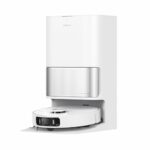
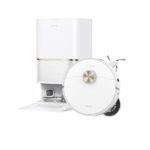
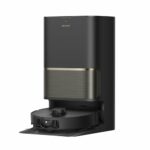
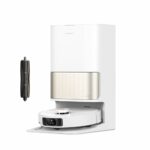
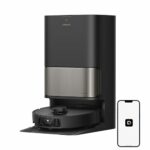
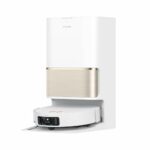
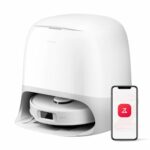
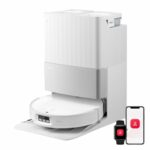
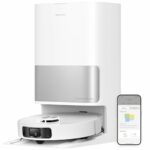
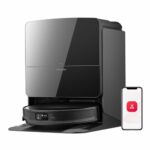
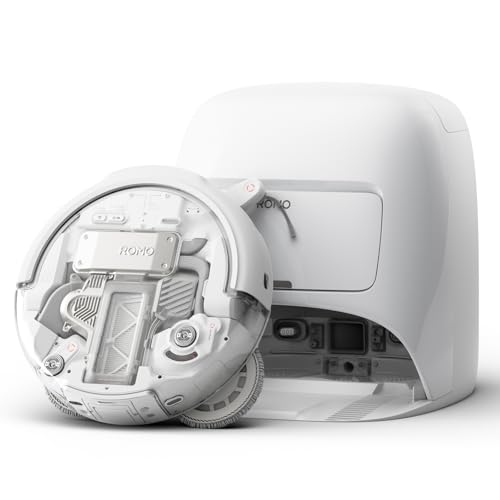
DJI has just entered the robot vacuum market with the Romo A (Robot Transparente), a 2025 model seeking to carve out a niche against established brands like Dreame. The latter presents the L10s Ultra Gen 2, launched in 2024 and part of its mid-to-high-end range with a multifunction base. Whilst DJI is betting on technological innovation with its first robot, Dreame relies on its previous experience to offer a reliable device at a competitive price.
The DJI Romo A stands out for incorporating cutting-edge technology with suction power that doubles its competitor, whilst the Dreame L10s Ultra Gen 2 focuses on offering greater autonomy and a base with more generous tanks. We're looking at two different approaches: one that prioritises power and advanced artificial intelligence, and another that seeks balance between features and extended working capacity.
Power and Suction
The most notable difference between these robots lies in suction power. The DJI Romo A (Robot Transparente) reaches 25000 Pa, a figure that far exceeds the Dreame L10s Ultra Gen 2's 10000 Pa. This difference isn't merely numerical: in practice it means that the DJI device can tackle high-pile carpets, ingrained dirt or heavier debris with greater effectiveness.
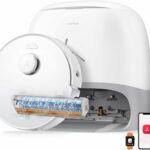
Regarding the brushing system, the DJI features a Dividido main brush (similar to other brands' DuoDivide system), specifically designed to reduce hair tangles. This brush comes pre-installed with anti-tangle technology. The Dreame uses a simple silicone brush to which an anti-tangle system can be attached, which involves an additional assembly step but also flexibility depending on household needs.
An important advantage of the DJI Romo A is that its main brush lifts during mopping, thus preventing it from getting wet or dirty when the robot is using the mop. The Dreame L10s Ultra Gen 2 doesn't have this function. Where the DJI also makes a difference is in the side brush: it has a double anti-tangle and extendable side brush to better reach corners. The Dreame model doesn't have an extendable or anti-tangle side brush, which may result in more manual maintenance.
Mopping
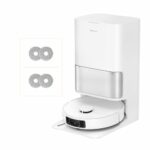
Both devices feature two rotating mops, currently the most effective system for domestic mopping. Both options lift their mops during vacuuming: the Dreame specifies a 10.5 mm lift, sufficient to avoid wetting thin carpets. Both models also extend the mops towards the edges, with the Dreame specifying that it reaches 3.0 mm with its Roboswing system, which allows the robot to make a lateral movement to introduce the mop under furniture overhangs.
Mop washing is present in both, although with differences in temperature. The DJI Romo A washes the mops with cold water, whilst the Dreame L10s Ultra Gen 2 also uses cold water during washing. There is variation in drying: the DJI dries with hot air (without specifying exact temperature), whilst the Dreame reaches 45°C. Hot air drying speeds up the process and helps prevent bad odours.
Where the DJI Romo A makes an important difference is in its ability to detect dirt both on the mops themselves and on the floor. This allows the robot to identify dirtier areas and automatically go over them again, or determine when the mops need washing again. The Dreame lacks these detection functions, which means it follows programmed patterns without adapting to the actual dirt encountered.
Navigation System
The DJI Romo A (Robot Transparente) is equipped with solid-state LiDAR, a more advanced and precise technology than the traditional turret Lidar fitted to the Dreame L10s Ultra Gen 2. Both systems allow precise mapping of the home, although solid-state usually offers faster and more reliable readings.
The major difference lies in the front camera. The DJI incorporates an AI camera with remote access, which allows the user to see in real time what the robot is capturing from the mobile app. Additionally, it includes night vision LED to work in low-light conditions. The Dreame L10s Ultra Gen 2 doesn't have an AI camera or remote access, which limits surveillance functions or visual monitoring of the home.
Both robots have a front 3D laser sensor to detect obstacles at floor level. Regarding intelligent recognition, the Dreame specifies that it recognises pets, whilst this specific aspect isn't detailed for the DJI. Both integrate intelligent AI-powered cleaning: the DJI with its own system and the Dreame with CleanGenius, although the DJI model adds specific stain recognition that the Dreame doesn't possess.
Autonomy and Battery
Battery capacity is very similar in both models: 5000 mAh in the DJI Romo A versus 5200 mAh in the Dreame L10s Ultra Gen 2. However, actual autonomy differs considerably. The Dreame reaches 240 minutes of continuous operation, whilst the DJI stays at 180 minutes. This one-hour difference can be decisive in large homes.
The DJI's greater suction power (25000 Pa) probably explains its lower autonomy: the greater the power, the higher the energy consumption. In practice, 180 minutes is still sufficient for most medium-sized homes, but for surfaces exceeding 150 square metres, the Dreame offers more margin without needing intermediate recharges.
Smart Functions
Neither robot incorporates a robotic arm or integrated voice assistant. In obstacle-crossing capability they're matched: both can overcome height differences of up to 20 mm, sufficient for most domestic thresholds and transitions between rooms.
Multifunction Cleaning Base
Both devices come with a multifunction base that includes auto-emptying, mop washing and drying. The main difference lies in the self-cleaning of the washing tray itself. The DJI Romo A (Robot Transparente) incorporates a system with automated nozzle that cleans the tray after each cycle, preventing dirt accumulation. The Dreame L10s Ultra Gen 2 uses a second-generation system but without specific tray self-cleaning.
Regarding capacities, the Dreame wins on the dust bag with 3.2 litres versus the DJI's 2.4, which translates to fewer manual emptyings. For water tanks, the Dreame also slightly exceeds the DJI: 4.5 litres of clean water and 4 litres of dirty water, compared to the DJI model's 4 and 3.2 litres respectively. These differences may seem small, but in large houses with extensive mopping surfaces, every litre counts to reduce refills.
The Dreame offers an optional plumbing connection kit purchased separately, allowing the base to be connected directly to the water supply and drainage. The DJI doesn't have this option. Neither includes UV disinfection.
Dimensions
The robots have practically identical dimensions. The DJI Romo A measures 351 mm in diameter and 98 mm in height, whilst the Dreame L10s Ultra Gen 2 has 350 mm diameter and 97 mm height. A one-millimetre difference doesn't represent any practical advantage: both will be able to pass under the same furniture and navigate similar spaces.
The bases do present more notable differences. The DJI's is wider (453 mm versus 340 mm) but less tall (440 mm versus 590.5 mm). Depth is smaller on the DJI (425 mm vs 456.7 mm). In practice, the Dreame base occupies less horizontal space but requires more clearance height, whilst the DJI's needs more width but can be placed under lower furniture.
Real-World Usage Experience
For households with pets, the DJI Romo A offers clear advantages thanks to its pre-installed anti-tangle main brush, its double anti-tangle side brush and suction power that can handle hair embedded in carpets. The Dreame doesn't fall behind, but requires more manual brush maintenance.
In large homes, the Dreame L10s Ultra Gen 2 wins on autonomy: its 240 minutes allow cleaning extensive surfaces without interruptions. Additionally, its more generous water tanks reduce the need to refill during long mopping sessions. The DJI, despite its lower autonomy, compensates with greater power that speeds up cleaning.
If you're looking for more intelligent and adaptive mopping, the DJI stands out for its dirt detection on floor and mops, which allows automatic re-cleaning of problematic areas. The Dreame performs effective mopping but without that real-time analysis capability. The DJI's tray self-cleaning also reduces base maintenance.
For those who value remote home monitoring, the DJI Romo A's AI camera with remote access and night LED adds extra functionality that the Dreame cannot offer. This can be useful for monitoring pets or simply checking the cleaning status from outside the home.
Conclusion: Which to Choose?
Choose the DJI Romo A (Robot Transparente) if... you're looking for the maximum suction power currently available, you have pets that shed a lot of hair, you value the most advanced technology with AI camera and remote access, or you need a system that automatically detects dirt and adapts its cleaning. Also if you prefer minimal maintenance thanks to tray self-cleaning and integrated anti-tangle brushes. It's the option for those who want the latest technology and don't mind paying for it.
Choose the Dreame L10s Ultra Gen 2 if... your priority is autonomy to clean large surfaces without recharging, you need higher-capacity tanks that reduce manual interventions, or you value the future possibility of connecting the base to plumbing. Also if you're looking for better value for money with reliable features without needing the latest technology. It's ideal for large homes where battery life makes the difference, and for users who prefer devices from an already established brand in the sector with mature and proven applications.