✨ VS Analyze · VacuumSpain comparison technology. AI-generated explanation based on verified technical data.
Introduction
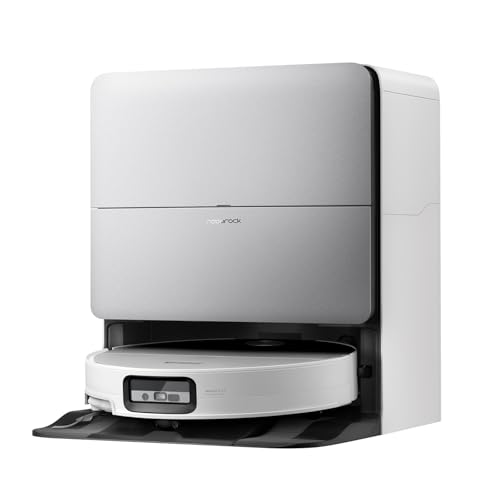
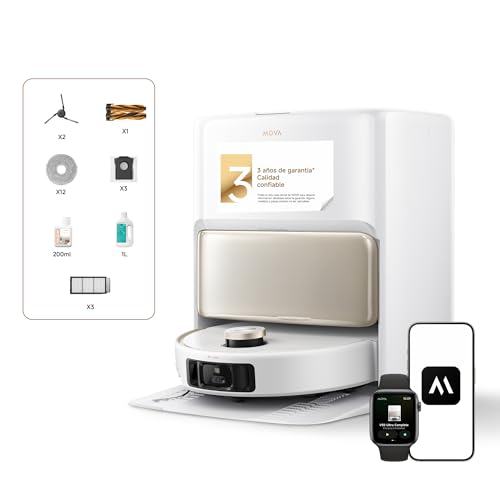
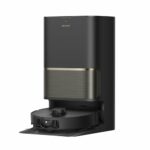
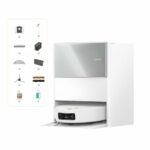
The Roborock Saros 20 Sonic and Mova V50 Ultra represent two distinct approaches to premium robotic cleaning. The Roborock model arrives from the world's leading manufacturer in this category, bringing 36,000 Pa of suction power and their distinctive DuoDivide anti-tangle brush system. The Mova V50 Ultra, from Dreame's secondary brand, offers 24,000 Pa alongside dual rotating mops and hot water floor mopping at 55°C.
These aren't entry-level machines. Both feature multifunctional bases with hot water mop washing, hot air drying, and intelligent AI navigation with dual cameras. The differences lie in cleaning philosophy, power delivery, and specific technologies that could make one considerably more suitable than the other depending on your home's characteristics.
Power and Suction
The suction power gap is substantial. The Roborock Saros 20 Sonic delivers 36,000 Pa, which places it amongst the most powerful domestic robots available. The Mova V50 Ultra's 24,000 Pa isn't weak by any measure, but the 12,000 Pa difference translates into noticeably stronger performance on carpets and when dealing with embedded dirt in textured flooring.
Both models share identical 6,400 mAh battery capacity. The Mova provides 220 minutes of runtime, whilst the Roborock's autonomy figure isn't specified in available data.
The main brush technology differs fundamentally. Roborock employs their DuoDivide anti-tangle system, which channels hair and fibres towards the central suction point rather than wrapping them around the brush. The Mova uses a dual anti-tangle brush configuration. Both approaches reduce hair tangling, though the DuoDivide design has proven particularly effective in homes with long hair or pets.
Side brush configurations are identical: both feature extensible, liftable, anti-tangle side brushes. This means edge cleaning capability should be comparable, with the brushes extending to reach corners then lifting during mopping to avoid cross-contamination.
Mopping
The mopping philosophies diverge completely. The Roborock Saros 20 Sonic uses a vibrating sonic mop system, oscillating rapidly to break down dried-on marks. The Mova V50 Ultra employs dual rotating mops that spin to scrub floors. Both approaches work, but sonic vibration typically handles stubborn stains more effectively whilst rotating mops cover larger areas more quickly.
Mop extension differs in execution. The Roborock extends its mop for edge cleaning, whilst the Mova incorporates SwingOut movement—a system where the robot shifts its body position to push the mop slightly under furniture edges and skirting boards. In practice, this can improve coverage in awkward areas.
Mop lift height varies: the Roborock offers 8-18 mm elevation (the range suggests adaptive lifting), whilst the Mova provides 10.5 mm. The Roborock's maximum 18 mm lift gives better clearance over thicker carpets and rugs.
Floor mopping temperature marks another clear distinction. The Roborock uses warm water for floor cleaning, whilst the Mova heats water to 55°C. Hotter water dissolves grease and grime more effectively, particularly in kitchens. This could be significant for households dealing with cooking spills or sticky residues.
Both robots wash their mops at the base with hot water and dry them using hot air, preventing odours and bacterial growth. Both can automatically detach mops at the base when you want vacuum-only cleaning. Both detect dirty mops and soiled floors, triggering rewashing or additional passes as needed.
Navigation System
Navigation hardware is remarkably similar. Both use retractable LiDAR for room mapping, dual AI cameras for object recognition, and frontal 3D laser sensors for obstacle detection. Both include LED lighting for night vision and offer remote camera access through their respective apps.
The Roborock Saros 20 Sonic recognises 300 different objects, compared to the Mova's 200. This broader recognition database means fewer instances where the robot might hesitate or require manual intervention around unusual items.
Both detect pets and curtains specifically—useful for avoiding tangling or startling animals. The Roborock employs SmartPlan 3.0 intelligence, whilst the Mova uses CleanGenius AI. Both systems learn room layouts, identify stains, and adapt cleaning patterns accordingly.
Battery and Autonomy
Battery capacity matches at 6,400 mAh. The Mova V50 Ultra provides 220 minutes of continuous operation, which should comfortably cover homes up to 200-250 square metres depending on floor type and cleaning mode intensity.
The Roborock's runtime isn't specified in the available data, though the identical battery capacity suggests comparable performance. Charging times aren't provided for either model.
Intelligent Functions
Obstacle climbing capability differs slightly. The Roborock manages simple steps up to 4 cm, whilst the Mova handles simple steps up to 3 cm. That extra centimetre might seem trivial, but it can determine whether the robot successfully navigates certain door thresholds or transitions between rooms with uneven flooring.
Both include proprietary voice assistants alongside compatibility with external systems like Alexa and Google Home. Neither features a robotic arm for advanced object manipulation.
Multifunctional Base
Both bases auto-empty dust, wash mops with hot water, and dry them with heated air. The key differences emerge in specific details.
The Roborock cleans its own washing tray using hot water. The Mova does likewise, employing third-generation technology for this self-cleaning function. The Mova adds UV disinfection, which the Roborock lacks—useful for households particularly concerned about bacterial contamination.
Detergent storage differs: the Roborock has a single detergent tank, whilst the Mova provides dual tanks. This allows the Mova to store different cleaning solutions for various floor types or cleaning tasks without manual refilling between uses.
Dust bag capacity favours the Mova at 3.2 litres versus 2.5 litres. This translates to less frequent bag replacement, particularly relevant for larger homes or those with heavy shedding pets.
Water tank capacities are close: both have 4-litre clean water tanks, whilst dirty water capacity is 3 litres for the Roborock and 3.5 litres for the Mova. The Mova's slightly larger dirty water tank matches its larger dust capacity, suggesting it's designed for marginally longer intervals between maintenance.
Neither offers integrated pipe connection or optional kits for plumbing integration, so both require manual water tank filling and emptying.
Dimensions
Robot diameter is nearly identical: 353 mm for the Roborock versus 350 mm for the Mova. Height differs more substantially: 79.8 mm versus 89.5 mm. That 9.7 mm difference could be critical. The Roborock's lower profile allows it to clean under furniture, beds, and cabinets that the taller Mova simply cannot access. In homes with low-clearance furniture, this becomes a decisive factor.
Base dimensions vary slightly. The Roborock measures 409 mm wide, 470 mm tall, and 440 mm deep. The Mova is 420 mm wide, 470 mm tall, and 458 mm deep. The Mova's base occupies a bit more floor space, though the difference is modest. Both require similar dedicated areas for installation.
Real-World Usage Experience
For larger homes, the Mova's bigger dust bag and water tanks reduce maintenance frequency. The 220-minute runtime comfortably handles extensive floor areas in a single session.
Pet owners benefit from both models' anti-tangle brushes, though the Roborock's 36,000 Pa suction proves more effective at extracting embedded pet hair from carpets and rugs. The DuoDivide brush design requires less manual cleaning after each use.
The Roborock's 79.8 mm height makes it indispensable for homes with low-clearance furniture. If your sofas, beds, or cabinets sit close to the floor, the Mova's 89.5 mm height will leave significant areas unreachable.
For households prioritising mopping performance, the Mova's 55°C hot water floor cleaning tackles grease and grime more aggressively than warm water. The dual detergent tanks add convenience if you regularly switch between floor types or cleaning solutions. The UV disinfection provides additional peace of mind, particularly in homes with young children.
The Roborock's superior suction and broader object recognition database suit homes with varied floor coverings, numerous obstacles, or particularly demanding cleaning requirements.
Conclusion: Which to Choose?
Choose the Roborock Saros 20 Sonic if: you need maximum suction power for deep carpet cleaning or pet hair extraction; your home has low-clearance furniture requiring a robot under 80 mm tall; you value the most advanced object recognition available; or you prefer sonic vibration mopping technology for stubborn stains.
Choose the Mova V50 Ultra if: you prioritise hot water floor mopping at 55°C for superior grease removal; you want dual detergent tanks for different cleaning solutions; UV disinfection matters for your household; larger dust and dirty water capacities reduce maintenance frequency; or your furniture clearances comfortably exceed 90 mm.
The Roborock suits homes where raw power, compact height, and comprehensive AI recognition deliver the most value. The Mova appeals to those who emphasise mopping performance, longer intervals between emptying, and additional hygiene features like UV disinfection. Neither represents a compromise—each excels in distinct areas that align with different household priorities.