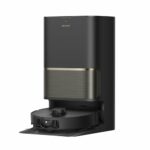
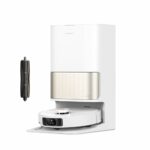
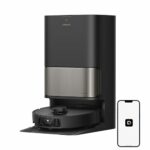
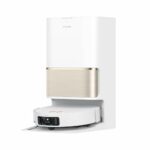
✨ VS Analyses · VacuumSpain comparison technology. Explanation created with AI from verified technical data.
Introduction
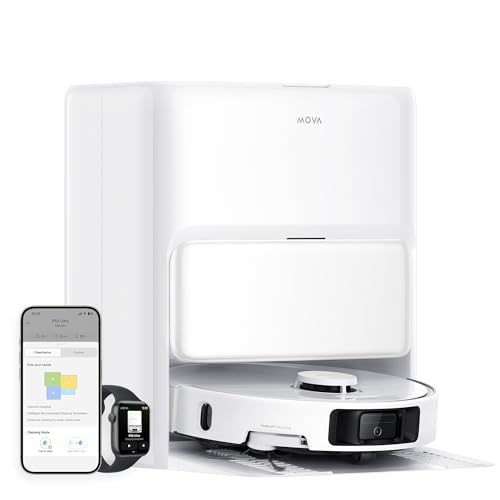
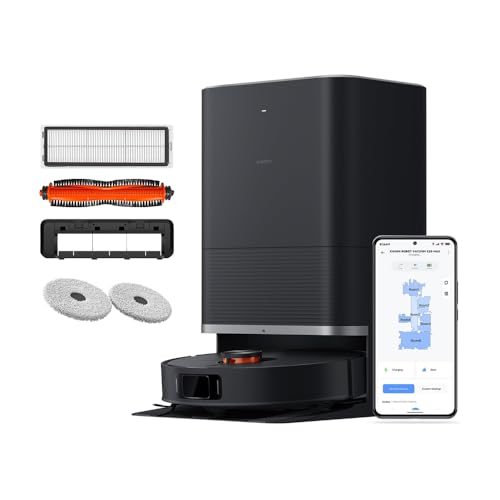
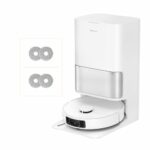
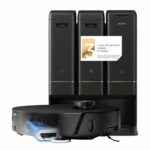
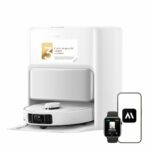
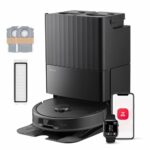
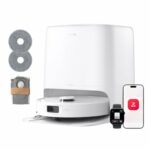
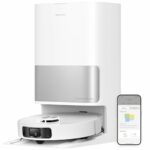
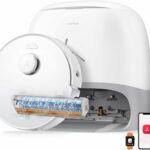
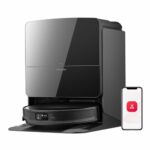
The Mova P50 Ultra and the Xiaomi X20 Max represent two high-end propositions in the robot vacuum cleaner market with multifunction base. The former arrives in 2025 as a renewed technological offering, whilst the latter was launched during 2024 consolidating Xiaomi's experience in this segment. Although they share identical dimensions in the robot—350 mm diameter and 97 mm height—the technical differences between both units are significant.
We are looking at two models designed for users seeking complete automation of mopping and vacuuming, with bases that wash and dry the mops without manual intervention. However, suction power, the brushing system and some details in the base mark different territories.
Power and Suction
The most striking difference in this robot vacuum cleaner comparison lies in suction power. The Mova P50 Ultra offers 19000 Pa Turbo, a figure that more than doubles the Xiaomi X20 Max's 8000 Pa. This gap proves decisive in homes with thick carpets, pets that shed abundant hair or floors with joints where persistent dirt accumulates.
The brushing system also marks distances. The Mova mounts a simple silicone brush that can be coupled with an anti-tangle model, whilst the Xiaomi equips the TriCut 3.0, which comes installed from the factory with specific design to cut hair. Both approaches seek to reduce tangles, albeit with different philosophies: one opts for modularity and the other for an integrated solution.
Where the Mova gains ground is in lifting the main brush during mopping. This function allows the robot to switch from vacuuming to mopping without dragging dirt from the brush onto the wet floor, something the Xiaomi X20 Max cannot do as it lacks this capability.
The Mova P50 Ultra's side brush adds three advantages: it is extendable to better reach corners, lifts during mopping to avoid splashing and features an anti-tangle design. The Xiaomi does not include any of these characteristics in its side brush, which limits its effectiveness in corners and increases manual maintenance.
Mopping
Both models employ dual rotating mop systems, which guarantees active mopping with constant pressure on the floor. Mop lift reaches 10.5 mm on the Mova and 10 mm on the Xiaomi, a minimal difference but sufficient to navigate small obstacles or thin carpets without wetting them.
Both feature mop extension to better cover edges. The Mova specifies that it uses version 3.0 of this system alongside Roboswing, a technology that allows the robot to perform lateral movements to introduce the mop under overhangs or low furniture. The Xiaomi also extends the mops, although it does not detail whether it incorporates similar movements.
Mop washing in the base shows temperature differences. The Mova P50 Ultra washes at 75°C, a specific figure that facilitates the elimination of grease and bacteria. The Xiaomi X20 Max also washes with hot water, but the exact temperature is not specified. For drying, the Mova uses air at 45°C, whilst the Xiaomi dries with hot air without specifying degrees.
Neither allows automatic removal of mops at the base to perform vacuuming-only tasks, nor detects dirt on the mops or floor to adjust mopping intensity. These functions remain reserved for models in higher segments.
Navigation System
Both the Mova robot vacuum cleaner and the Xiaomi robot vacuum cleaner mount Lidar 3D turret to map the home with precision. Both include a front 3D laser sensor that improves detection of obstacles at floor level, avoiding cables, shoes or small toys.
The Xiaomi X20 Max incorporates night vision LED, which allows it to identify objects in low-light conditions without relying solely on the laser. The Mova P50 Ultra does not feature this front lighting, although its navigation system remains effective thanks to the Lidar and 3D sensors.
An exclusive function of the Mova is curtain detection. This detail prevents the robot from tangling in long fabrics that hang to the floor, something that can occur with lounge or bedroom curtains. The Xiaomi lacks this specific capability.
Neither model equips AI camera for advanced visual recognition, nor allows remote camera access from the app. Neither do they specifically recognise pets nor detect stains through artificial intelligence. Both have intelligent cleaning functions—CleanGenius in the case of the Mova—which adjust parameters according to floor type or dirt level detected by other sensors.
Autonomy and Battery
Both units mount 5200 mAh batteries, a standard capacity in high-end robots. The Xiaomi X20 Max specifies an autonomy of 120 minutes, sufficient to cover medium-sized homes in a single session. The Mova P50 Ultra does not detail exact minutes of continuous operation, although the identical battery capacity suggests similar performance.
In practice, actual autonomy will depend on the cleaning mode selected. The Mova's 19000 Pa power will consume more energy in maximum mode than the Xiaomi's 8000 Pa, which may shorten effective working time if used at full power constantly.
Intelligent Functions
The Mova P50 Ultra overcomes obstacles up to 22 mm, whilst the Xiaomi X20 Max reaches 20 mm. This 2 mm difference may seem minimal, but proves relevant when facing sliding door guides, thick carpet frames or small level changes between rooms.
Neither model incorporates a robotic arm nor own voice assistant integrated in the robot. Intelligent functions focus on adaptive navigation, automatic power adjustments and map management from the mobile application.
Multifunction Cleaning Base
The Mova P50 Ultra's base includes a third-generation washing tray self-cleaning system, already installed from the factory. This mechanism reduces manual maintenance by automatically cleaning the area where mops are washed, preventing dirt accumulation and bad odours. The Xiaomi X20 Max does not have this function, which requires manual tray cleaning more frequently.
The Mova offers the option to add a detergent tank, although it is an optional accessory. The Xiaomi does not contemplate this possibility, limiting the use of specific cleaning products during mop washing.
The Mova's dust bag reaches 3.2 litres, compared to the Xiaomi's 2.5 litres. This greater capacity extends emptying intervals, especially useful in homes with pets or during periods of greater dirt. Both models share 4-litre clean water tanks, but the Mova specifies a 3.5-litre dirty water tank, data that is not available for the Xiaomi.
Neither allows integrated connection to water pipes, nor includes an optional kit to do so. Neither do they incorporate UV disinfection in the base.
Dimensions
The robot itself maintains identical measurements: 350 mm diameter and 97 mm height. This uniformity allows them to slip under most sofas and beds with legs of at least 10 cm height.
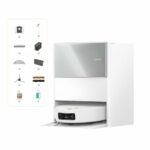
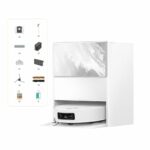
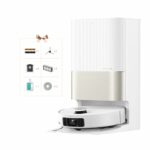
The bases present different proportions. The Mova P50 Ultra's measures 420 mm wide, 470 mm tall and 458 mm deep. It is wider and deeper, but considerably lower. The Xiaomi X20 Max's base occupies 340 mm wide, 563 mm tall and 420 mm deep, resulting narrower but notably taller.
This difference conditions placement. The Mova's base needs more horizontal space, ideal if placed under a worktop or in a spacious corner. The Xiaomi's, more vertical, fits better in narrow spaces where height is not limiting.
Real-World Usage Experience
For large homes or those with multiple rooms, the Mova P50 Ultra provides clear advantages: greater suction power, larger dust bag and tray self-cleaning system that reduces maintenance. The ability to overcome 22 mm facilitates passage between rooms with small level changes.
In homes with pets, the power difference—19000 Pa versus 8000 Pa—is especially noticeable on carpets and rugs where hair accumulates. The Mova's extendable and anti-tangle side brush also scores points by collecting hair from corners without tangling as much.
The Xiaomi X20 Max proves more compact in the base, which facilitates its integration in reduced spaces. The night vision LED may prove useful in dark corridors or if the robot works at night, although it is not a critical function thanks to the Lidar.
Both models mop effectively with rotating mops, hot water washing and thermal drying. The Mova specifies specific temperatures (75°C washing, 45°C drying), which provides greater transparency. The Mova's mop extension with Roboswing can make a difference in kitchens with protruding skirting boards or bathrooms with low furniture.
Conclusion: Which to Choose?
Choose the Mova P50 Ultra if you seek the maximum suction power available in this robot vacuum cleaner comparison, you have pets that shed a lot of hair or thick carpets requiring intense vacuuming. Also if you value minimal maintenance thanks to the third-generation tray self-cleaning and prefer a lower base that fits under worktops. The ability to lift the main brush during mopping and the extendable side brush are additional advantages for more thorough cleaning in corners and edges.
Choose the Xiaomi X20 Max if you have a narrow space to place the base and prefer a more compact model in width. The night vision LED may prove practical if the robot cleans during low-light hours. Although it offers lower suction power, the 8000 Pa remains sufficient for hard floors and medium-thickness carpets in homes without pets or with lower vacuuming demands. Its TriCut 3.0 system comes installed and works well under normal usage conditions.
For large houses over 100 m², the Mova P50 Ultra emerges as the better option due to its larger dust bag capacity and superior power. If you live in a small or medium-sized flat, without thick carpets or pets, the Xiaomi X20 Max covers needs with a base that occupies less horizontally. Ultimately, the choice depends on the type of usual dirt, available space for the base and the level of automation you seek in daily maintenance.