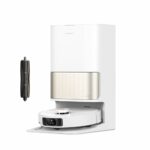
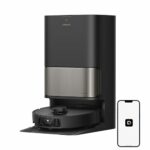
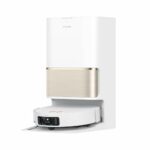
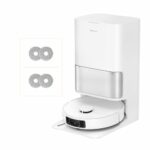
✨ VS Analyses · VacuumSpain comparison technology. Explanation created with AI from verified technical data.
Introduction
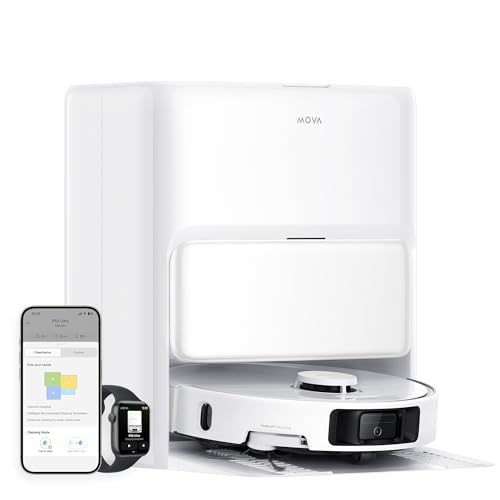
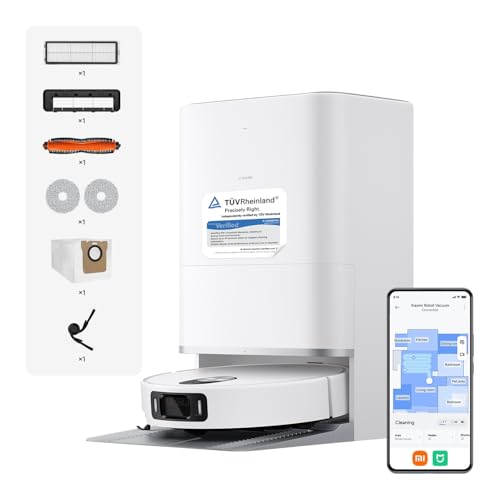
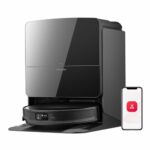
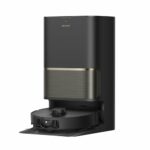
The Mova P50 Ultra and the Xiaomi Robot Vacuum 5 Pro arrive on the market in 2025 as two high-end propositions that share many advanced features. Both devices are designed to offer complete cleaning with powerful suction and mopping with rotating mops, as well as featuring multifunctional bases that wash and dry the mops automatically. This technology makes the difference between basic mopping and truly effective mopping, as the mops are cleaned during the process and dried at the end to prevent bad odours.
Although they share design philosophy and many features, there are technical differences that may tip the balance depending on each household's needs. The choice between one or the other will depend on factors such as the home's layout, the presence of pets, or the importance given to certain smart functions.
Power and Suction
In terms of raw power, the Xiaomi Robot Vacuum 5 Pro sits slightly ahead with 20,000 Pa compared to the Mova P50 Ultra's 19,000 Pa. This difference of 1,000 Pa may be particularly noticeable on carpets or when there is accumulated ingrained dirt, although in daily practice both offer more than adequate performance for most households.
The most relevant difference lies in the main brushing system. The Xiaomi incorporates the TriCut 3.0 system, which combines bristles with blades designed to cut tangled hair and fur. The Mova has a simple brush, which may mean more maintenance in households with pets or people with long hair. For those living with animals, this Xiaomi feature is especially practical.
Both models lift the main brush during mopping, preventing it from getting unnecessarily wet. They also feature an extendable and anti-tangle side brush. However, the Mova adds a function that the Xiaomi doesn't have: the side brush lifts during mopping. This prevents the side brush from splashing or spreading dirty water whilst mopping, maintaining a cleaner and tidier process.
Mopping
Both robots use two rotating mops for mopping, a system that offers better results than static dragging mops. Both extend the mops to better reach edges, although the Mova also incorporates the Roboswing system, a swinging movement that allows the mop to get under certain furniture or protrusions.
Mop lifting shows a notable difference: the Xiaomi raises them up to 15 mm, whilst the Mova reaches 10.5 mm. Those extra millimetres on the Xiaomi can make the difference on medium-pile carpets or thick doormats, allowing the robot to pass over them without wetting them. In homes with many carpets, this capability becomes important.
The Xiaomi incorporates dirt detection both on the mops and on the floor, which allows it to adjust the cleaning process intelligently. If it detects that the mops are still dirty after washing, it can repeat the cycle. If it identifies particularly dirty areas on the floor, it can go over those areas again. The Mova lacks these automatic detection functions.
Both bases wash the mops with hot water and dry them with hot air, guaranteeing hygienic maintenance. The Mova offers third-generation tray self-cleaning and allows adding an optional detergent tank that is purchased separately. The Xiaomi does not include this detergent option, although its tray self-cleaning system is also present.
Navigation System
Here we find one of the most marked differences between both models. The Xiaomi integrates an AI camera with remote access, which allows you to see in real time what the robot is viewing from the mobile app. Additionally, it features night vision LED for navigating in low-light conditions. The Mova does not have an AI camera or remote access.
The Mova uses a traditional 3D LiDAR turret, whilst the Xiaomi has a retractable LiDAR. Both systems work well for mapping and navigation, although the retractable one may offer a slightly lower total height at certain times. Both devices feature a front 3D laser sensor to avoid obstacles.
The Xiaomi recognises up to 200 different types of obstacles, a figure that is not specified for the Mova. This recognition capability is useful for avoiding cables, toys, shoes, or any object that might hinder cleaning. The Mova detects curtains, a function that the Xiaomi doesn't specifically mention, which can help avoid tangles with long curtains.
Both robots feature intelligent AI cleaning, but the Xiaomi adds AI stain recognition, allowing it to identify and treat particularly dirty areas autonomously.
Autonomy and Battery
Both models have 5,200 mAh batteries, a generous capacity that should guarantee sufficient autonomy for large homes. The Xiaomi specifies 140 minutes of autonomy, a detail that the Mova doesn't provide. In practice, this autonomy allows cleaning large surfaces without needing intermediate recharges.
Smart Functions
The Mova P50 Ultra can overcome obstacles up to 22 mm in height, two millimetres more than the Xiaomi's 20 mm. Although it may seem little, this difference can be decisive with certain door profiles, thick carpets, or small level changes between rooms. For homes with irregular transitions between rooms, those extra millimetres on the Mova can prevent the robot from getting stuck.
Both robots are compatible with external voice assistants such as Alexa or Google Home, facilitating control by voice commands.
Multifunctional Cleaning Base
Both bases perform auto-emptying of the dust container, washing mops with hot water, and drying with hot air. Both include self-cleaning of the washing tray, a function that reduces manual maintenance.
The Mova's dust bag has greater capacity: 3.2 litres compared to the Xiaomi's 2.5 litres. This translates to less frequent bag changes, especially useful in households with pets or high dust generation. The clean water tanks are identical (4 litres), whilst the dirty water tank is slightly larger on the Xiaomi (3.8 litres compared to 3.5 litres).
The Mova allows adding an optional detergent tank, something that must be purchased separately and isn't essential but can improve mopping results. The Xiaomi does not include this option.
Dimensions
The diameter is identical on both: 350 mm. The difference is in height: the Xiaomi measures 88 mm, whilst the Mova reaches 97 mm. Those 9 millimetres can determine whether the robot passes under certain low furniture, sofas, or beds or not. For homes with low-height furniture, the Xiaomi has an advantage.
The bases have different dimensions. The Mova's is wider (420 mm compared to 360 mm) but less tall (470 mm compared to 572 mm). The Xiaomi's is narrower but considerably taller. Depending on available space, one configuration may fit better than the other.
Real-World Usage Experience
For households with pets, the Xiaomi presents clear advantages thanks to the TriCut 3.0 brush and its greater mop-lifting capacity. The main brush's anti-tangle system reduces maintenance, something that's appreciated when there's animal hair constantly.
In homes with low furniture, the Xiaomi's lower profile (88 mm) allows access to spaces that the Mova wouldn't reach. If you have sofas or beds with little clearance, this difference is decisive.
The Mova stands out in houses with level changes or complicated transitions between rooms, thanks to its ability to overcome 22 mm obstacles. It's also interesting if you prefer to change the dust bag less frequently, given its larger size.
The Xiaomi's AI camera with remote access provides peace of mind if you want to monitor the house whilst you're away or simply see what the robot is doing at any given moment. Dirt detection on mops and floor also makes the process more autonomous and efficient.
Conclusion: Which to Choose?
Choose the Mova P50 Ultra if: You have level changes at home or complicated transitions between rooms, you prefer to change the dust bag less often thanks to its 3.2-litre capacity, you value the liftable side brush for cleaner mopping, or you're interested in the option to add detergent to the base. Also if you have long curtains that might pose a problem.
Choose the Xiaomi Robot Vacuum 5 Pro if: You live with pets and need an effective anti-tangle brush, you have low furniture and need a robot with lower height, you want remote camera access for surveillance or control, you value automatic dirt detection for more intelligent mopping, or you have thick carpets that require greater mop lifting (15 mm). Its greater suction power and recognition of up to 200 obstacles also make it stand out in intelligent navigation.